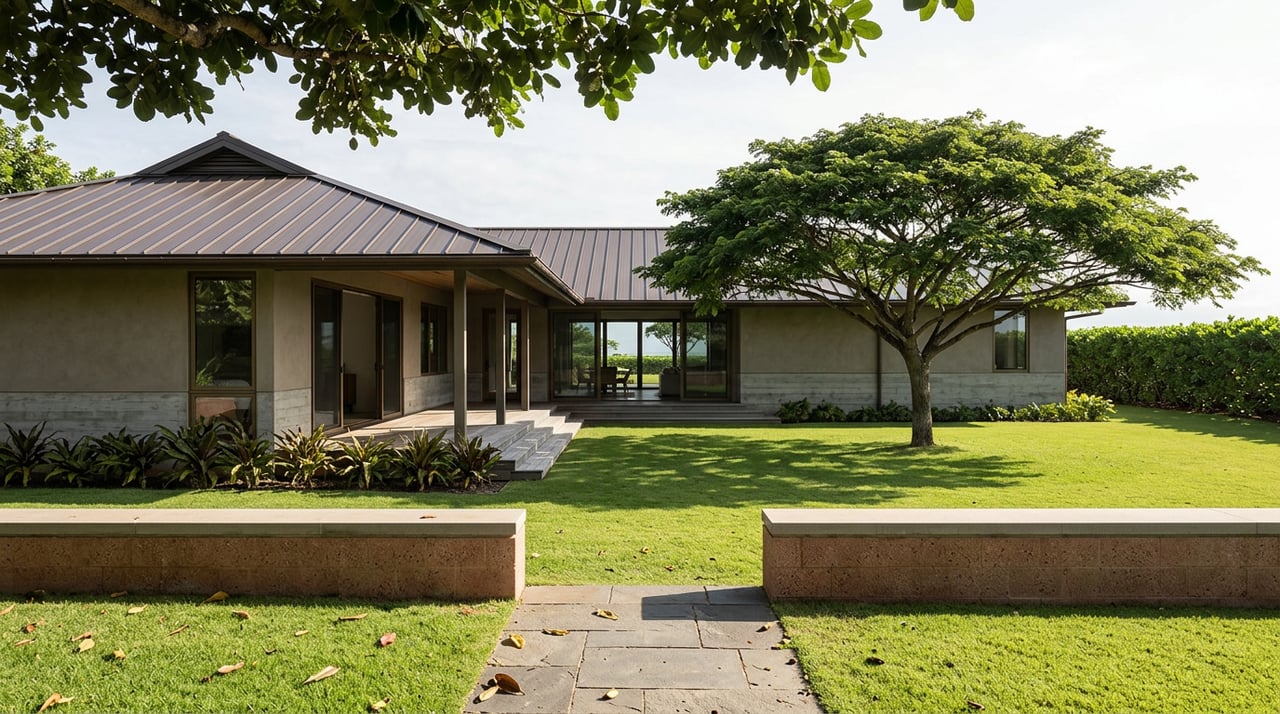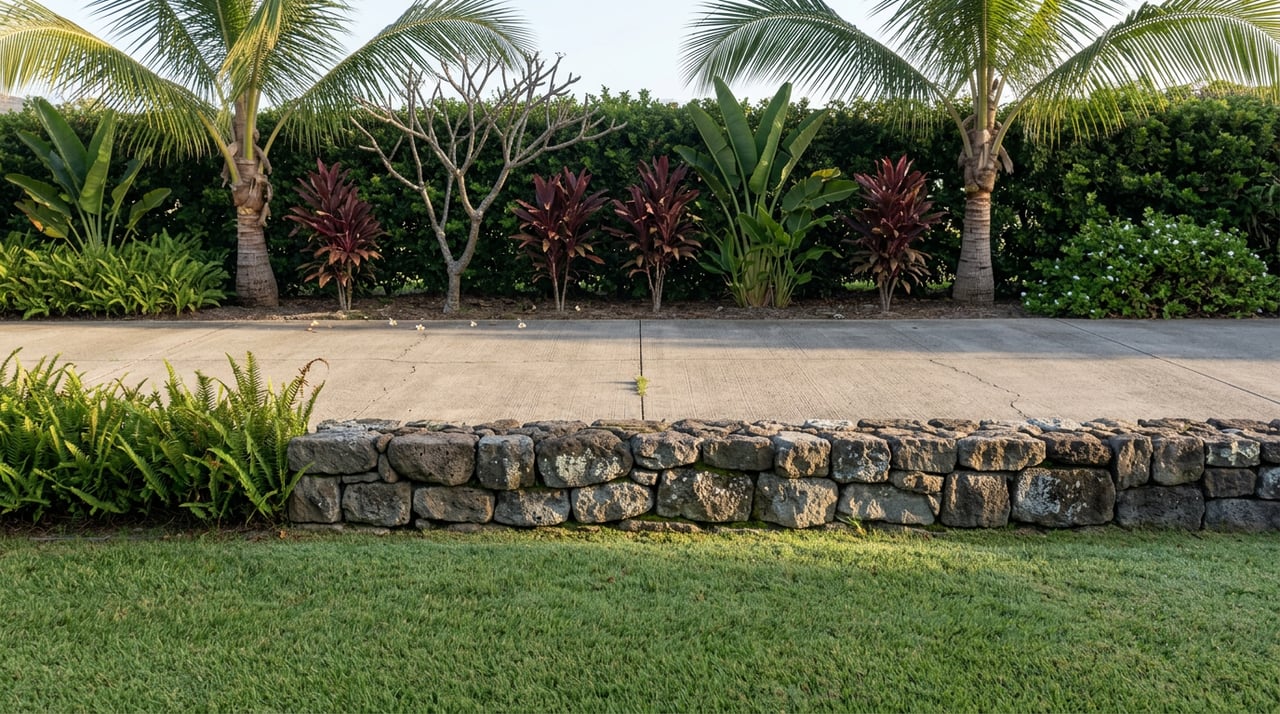
Why does a wall of stacked boulders in front of one Mokulua Drive estate carry a fifty-five-year legal easement, while the sandbags in front of another house a few doors down have sat there since the 1990s with no permanent status at all? Both look the same from the road. Both protect an oceanfront lot. Only one of them has paperwork that survives a title search cleanly.
That gap is the thing buyers moving toward Lanikai's turquoise water and towering listing prices tend to miss. The beach isn't the asset. The legal right to keep the ocean off your lawn is, and in Lanikai that right was handed out unevenly, decades apart, under different rules, to different owners, for different reasons. What you're actually buying when you buy "oceanfront" here depends less on your address and more on when your seawall got its permit.
The Wall That Turned Into Fifteen Million Dollars
Start with 1240 Mokulua Drive. The seawall there predates Hawai'i's coastal protection laws entirely, built sometime before the 1960s. In 2003, a buyer paid $6 million for the property and then went to the state for something specific: an easement to keep that old wall in place for another fifty-five years. The state said yes. With the wall secured, the owner redeveloped the estate, and it was listed for sale at $21 million, according to ProPublica's investigation into Hawai'i's disappearing beaches. That easement runs through 2058, which means whoever eventually buys that wall's protection is buying roughly three more decades of it, not a permanent guarantee.
A few lots away, at 1562 Mokulua Drive, a different pattern played out. A wall of boulders went up there without approval, a clear violation. Despite that, the City and County of Honolulu issued building permits in 2009 that let the owner redevelop the property into a luxury estate. It sold in 2015 for $9.35 million, more than double what it fetched in 2006.
Neither of these outcomes came from a formula anyone could have predicted from the outside. They came from case-by-case decisions by state and county officials who, as ProPublica's reporting lays out, have consistently chosen leniency over enforcement when it comes to unwinding armor on this particular stretch of coastline. That leniency is itself a market force. It has kept Lanikai's shoreline fixed in place while the sand in front of it disappeared, and it has let redevelopment and appreciation continue on lots that, under a stricter reading of the law, might never have qualified for a rebuild permit at all.
If you're comparing two Lanikai listings side by side, the square footage and the view will look nearly identical. The legal footing underneath the seawall will not. One property's protection has a documented expiration date. Another's rests on a decades-old sandbag arrangement that was only ever supposed to be temporary. A third might have no documented approval at all, which becomes your problem the day you want to touch it.
Why Only a Handful of Houses Actually Touch the Sand
Lanikai has roughly 500 homes. Of those, about 105 have some claim to ocean frontage. Only around 25 sit directly on the sandy beach itself. That means the word "oceanfront" in a Lanikai listing is doing a lot of quiet work, covering everything from a house with fifty feet of private beach access to a house whose relationship to the water is mediated entirely by a wall, a rock revetment, or a stretch of sand that isn't there most of the year.
The sand itself isn't a fixed feature either. It's actively managed, and not always in the direction people assume. Excess sand that piles up at Kailua Beach Park has, at times, been hauled over and placed on Lanikai's beach, which chronically needs it more. Ned Dewey, who led the Lanikai Association for years, pushed back on the common assumption that Lanikai's sand simply drifts toward Kailua on its own, describing a Kailua-to-Lanikai transfer as completing a cycle rather than one beach stealing from the other.
That detail matters for anyone picturing "beachfront" as something the ocean supplies for free. In Lanikai, the sand in front of a given home can be the product of a public decision made somewhere else on the coastline, not a fixed natural feature that comes with the deed. If funding or priorities shift toward other eroding beaches around O'ahu, there's no guarantee that sand keeps showing up.
The Setback Line Moved in 2024. Existing Houses Didn't.
For years, new construction on O'ahu's shoreline only had to sit back 40 feet from the certified shoreline. In 2024, Honolulu's Ordinance 23-3 changed that formula for new builds: the setback is now 60 feet plus 70 times the property's annual coastal erosion rate, capped at 130 feet. On a lot with a fast erosion rate, that can push new construction back more than three times as far from the water as the old rule required.
Here's the part that creates the value gap. That new formula applies to new construction and substantial redevelopment. It does not retroactively apply to a house that was built decades ago and now happens to sit inside the new, larger setback zone. Under the ordinance's own language, that house becomes a "legal nonconforming structure," a structure that was lawful when built and remains standing, but that couldn't be built again today in the same spot.
That status cuts two ways for a buyer. It can be a relief: the house is allowed to exist and, in many cases, to be maintained. It can also be a limitation: substantial renovation, a teardown-and-rebuild, or any project that counts as a fresh start under the ordinance may trigger the new setback, meaning the next owner might not be able to reconstruct anything close to what's there now. A Lanikai property that reads as move-in ready oceanfront paradise today can carry a hidden ceiling on what you're allowed to do with it tomorrow, and that ceiling is invisible unless someone pulls the shoreline certification and checks.
A New State Law Just Reopened the Question
On July 8, 2026, Governor Josh Green signed SB 2401 into law as Act 207, the most structurally significant coastal measure to come out of this year's legislative session. It directs the state's Office of Planning and Sustainable Development to designate regional shoreline mitigation districts and coordinate long-term adaptation plans for them, shifting shoreline decisions from a parcel-by-parcel basis to a whole-stretch-of-coast basis.
What that means in practice is still unsettled. Coastal advocates have flagged a real concern: the permit provisions written into these new districts could make it easier, not harder, to armor a shoreline once a property falls inside one. Whether that happens depends entirely on how the planning office writes its implementing rules, a process that is still underway as of this fall.
Layer that uncertainty onto an enforcement climate that has clearly hardened. As of May 2026, the Department of Land and Natural Resources had issued 257 violations for unpermitted land use on O'ahu since 2020, with roughly 80 percent of those tied to shoreline issues. In May 2026, two North Shore homeowners began tearing out nearly $2 million in fines' worth of illegal tarps, sandbags, and concrete after years of standoff with the state, a case the Star-Advertiser covered in detail. The agency's position on unauthorized armoring has been unambiguous:
"Homeowners do not have a legal right to claim public lands in order to build private revetments and seawalls."
That statement wasn't made about Lanikai specifically, but it describes the same legal framework every Lanikai seawall operates under. A property whose protection rests on a decades-old, informally tolerated structure is now sitting inside a regulatory environment that is actively cracking down on exactly that kind of arrangement elsewhere on the island.
Before You Write an Offer
A Lanikai purchase moves at a different pace than a typical O'ahu closing once shoreline work is part of the picture. Before you get attached to a number:
- Ask for a current certified shoreline survey. If the one on file is more than a year old, budget time and cost for a new one before you can rely on it.
- Request the full permit and easement history for the specific parcel, not just the neighborhood. DLNR and the Department of Planning and Permitting hold these records, and they are public.
- Find out whether the seawall or revetment in front of the house is permitted, grandfathered, or undocumented. Each status carries a different level of risk if the structure is ever damaged.
- Confirm whether the lot falls inside the new 60-130 foot setback zone for new construction, since that number determines what you can and cannot rebuild later.
- Talk to an insurer early. Flood and coastal risk pricing on an armored lot with an uncertain permit history can differ meaningfully from a comparable lot with clean paperwork.
A Few Questions Worth Asking Directly
What is a certified shoreline, and why does it expire? A certified shoreline is an official survey, approved by the state land surveyor, that pins down exactly where the regulatory shoreline sits on a given date. Because the coastline moves, certifications are treated as time-limited, and most transactions and construction projects require one that's current.
Can I build a new seawall in Lanikai if mine fails? Not easily. State and county policy has leaned toward a no-tolerance stance on new shoreline hardening since 1999, and if an existing wall is significantly damaged, the law limits what an owner can do to repair or replace it. Some owners have secured approvals anyway, which is exactly why permit history matters more than the wall's current condition.
Does the new setback ordinance affect a house I already own or want to buy as-is? Generally not for simple maintenance. It becomes relevant the moment a project counts as substantial reconstruction or new development, which is when a legal nonconforming structure can lose the right to rebuild in its current footprint.
None of this means Lanikai is a bad bet. It means the price tag reflects the view, and the legal position of the seawall in front of it deserves its own line item in your due diligence, not an afterthought after the inspection. If you're weighing a specific Lanikai property and want someone who will pull the permit history before you fall in love with the lanai, reach out to Kalei Wodehouse to schedule a personal consultation.